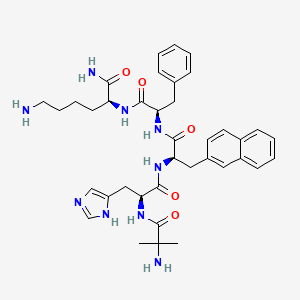
A sponsored article published on Elizabethton.com argues that a blend of Fragment 176-191, Modified GRF 1-29, and Ipamorelin offers researchers a way to study several signaling pathways at once rather than one receptor in isolation.
The three components are familiar names in growth hormone research. Fragment 176-191 is described as a synthetic peptide derived from the C-terminal region of growth hormone, Modified GRF 1-29 as a stabilized analog of growth hormone-releasing hormone also known in some research settings as CJC-1295 without DAC, and Ipamorelin as a selective growth hormone secretagogue acting at the ghrelin receptor.
Two receptors, one argument
The case for the combination rests on the fact that Modified GRF 1-29 and Ipamorelin engage different receptor systems: growth hormone-releasing hormone receptors in the first case, growth hormone secretagogue receptors in the second. The piece says those systems converge downstream on intracellular pathways involving protein kinases, transcription factors, and gene regulatory mechanisms, which is why investigators have theorized that engaging both at once might reveal something about how hypothalamic signaling networks synchronize naturally.
Fragment 176-191 is positioned as the metabolic leg of the stool. According to the article it is not a classical secretagogue, and has instead been investigated mainly for its relationship with lipid regulatory pathways and adipose tissue biology.
The language is doing a lot of work
Read the verbs and the shape of the thing becomes clear. "Investigations purport," "researchers have theorized," "may provide," "might influence": every mechanistic statement in the piece is conditional, and the article never once says what any specific experiment measured or found.
The five citations at the foot of the article are a useful tell. They are reviews and foundational receptor papers from 1996 to 2015 on growth hormone-releasing hormone, ghrelin, and secretagogue biology in general, not studies of this blend.
What is actually missing
No trial appears anywhere in the article, in humans or in animals. There is no dose, no species, no duration, no outcome figure, and no researcher or clinician quoted by name.
This is disclosed sponsored content, and it reads like a category explainer rather than a report of a result. That is worth saying plainly, because mechanism writing of this kind tends to get recirculated as though a finding had been established somewhere.
Bottom line
The underlying receptor biology the article leans on is real and long documented. What has not been shown, at least not anywhere in this piece, is that combining these three peptides produces any measured outcome at all.
Comments (0)
Discussion happens on Reddit.
Go to r/PeptideNewsroomQuestions and corrections go to r/PeptideNewsroom.