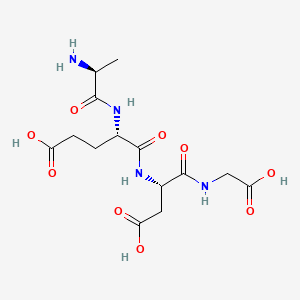
Epitalon, spelled Epithalon in earlier literature, is a synthetic tetrapeptide made of four amino acids: alanine, glutamic acid, aspartic acid and glycine. It has spent two decades attached to telomere research and has now landed in the middle of a federal compounding fight, which makes it worth separating what laboratories have reported from what regulators have actually done.
Telomeres in cultured cells
The foundational work came from one group. Researchers at the St. Petersburg Institute of Bioregulation and Gerontology reported in 2003 that Epithalon induced expression of the catalytic component of telomerase, increased telomerase activity and lengthened telomeres in cultured human fetal fibroblasts, according to a summary published by California Trim Clinic, a clinic that sells compounded Epitalon. A 2004 follow-up from the same group reported that treated fibroblasts kept dividing past the point where untreated cells lost proliferative capacity. Cell culture, not people.
The 2025 replication, and its complication
A separate team at Brunel University London revisited the question, and the 2025 Biogerontology study reported dose-dependent telomere extension in normal human epithelial cells, fibroblasts and two breast cancer lines, 21NT and BT474. In the normal cells that came with increased hTERT expression and telomerase activity. In the cancer lines it ran through a different route, Alternative Lengthening of Telomeres, with no significant telomerase increase. Independent replication matters here, because almost everything before it came from one lab.
Why the policy changed
Epitalon is one of six peptides covered by an HHS enforcement-discretion policy issued October 29, 2026, reported by Fortune, alongside BPC-157, KPV, MOTS-c, Semax and TB-500. The advisory committee voted 8-6 in favor after FDA scientists repeatedly said there was not enough safety and efficacy information to justify it.
What Isn't Established
No human trial appears anywhere in either source. The cell findings do not establish that Epitalon lengthens telomeres in a patient, slows aging or extends lifespan, and the 2025 study was not designed to assess clinical cancer risk. Enforcement discretion is not approval: compounded drugs are not FDA-evaluated for safety, effectiveness or quality, and compounding pharmacies have no obligation to test ingredients obtained from outside suppliers.
Where the evidence stands
Two decades of work, all of it in cells, now with one independent replication attached. The regulatory status moved first, and the human data has not moved at all.
Comments (0)
Discussion happens on Reddit.
Go to r/PeptideNewsroomQuestions and corrections go to r/PeptideNewsroom.