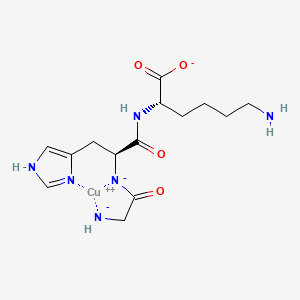
GHK-Cu, also listed on product labels as copper tripeptide-1, is a three amino acid peptide (glycine, histidine, lysine) bound to a single copper ion. It occurs naturally in human plasma, it was identified in the 1970s, and it is currently one of the busiest ingredients in both skincare marketing and research-peptide catalogs.
A discovery that was not about skin
Board-certified dermatologist Dr. Mona Foad told Yahoo that the peptide was found almost by accident: Dr. Loren Pickart noticed that blood plasma from younger donors triggered stronger tissue regeneration in liver studies than plasma from older donors, and GHK-Cu turned out to be the molecule behind the difference. "It wasn't invented for skin care," Foad said. "It was found because of what it does in the body."
That origin matters more than the usual ingredient-story flourish, because it means the earliest evidence base is surgical and biological rather than cosmetic.
Gene expression in cell culture
The laboratory literature clusters around collagen synthesis, dermal remodeling, wound-healing models and antioxidant gene activity. Pickart reports in Cosmetics, as summarized in a compound roundup, that "GHK induces a 50% or greater change of expression in 31.2% of human genes."
That is a striking figure and it is also a cell-level one. It describes what happens to gene expression in a model, not what happens to a person's skin.
Two declines landing on the same tissue
Pickart and Margolina report in the International Journal of Molecular Sciences that "at age 20, the plasma level of GHK is about 200 ng/mL, and by the age of 60, it declines to 80 ng/mL." Separately, Brincat and colleagues in Obstetrics and Gynecology found skin collagen content, skin thickness and forearm bone mineral content each "showed a decline of between 1-2% per year after the menopause."
Those are two independent curves, not one causal chain, and the roundup is careful to say so. Whether falling plasma GHK helps drive the collagen decline or simply runs alongside it is the open question researchers want tested.
Wound settings versus antioxidant claims
Asked which effects hold up best, Foad said the wound-healing effects are "the most clinically established of the three since GHK-Cu was used in surgical and wound settings before it ever appeared in a serum." Collagen and elastin support is described as reasonably well documented, while dermatologist Dr. Alexandra Bowles called the antioxidant claim "a supportive property rather than the main reason to reach for this ingredient."
That is a useful hierarchy, and it is the opposite of how most bottles are labeled, where antioxidant language usually gets equal billing.
What Isn't Established
Controlled human trials in a post-menopausal population are thin, per the same roundup, which rates the mechanistic and cell-culture evidence as strong and the human trial evidence as not. Foad also draws a hard line on the cosmetic end: GHK-Cu is not a retinol replacement, and while it might help with fine lines, it will not erase deep wrinkles.
No source here quantifies a skin outcome in a human trial. Claims about firmer skin and smaller pores in the product copy quoted by Yahoo are marketing language, not trial results.
Where the evidence stands
GHK-Cu sits in an unusual spot: a long mechanistic pedigree, a real clinical history in wound settings, and very little in the way of modern controlled trials on the aging-skin uses it is now sold for. The gap between how well the pathway is characterized and how little the human outcome data says is the thing to watch.
Comments (0)
Discussion happens on Reddit.
Go to r/PeptideNewsroomQuestions and corrections go to r/PeptideNewsroom.